
En Route to Publication
Part 2 of a Series about publication from my POV


As I over-promoted my two recent books on social media, emails to podcasts, emails to newspaper editors, I’ve been asked some great questions about the publishing process. I thought I would lift the veil behind how I went from NYT article to becoming a spokesperson for abortion rights campaigns in 2024, to actually writing a manuscript.
Here’s a version of the story. I’ll write more versions soon.
I have an agent who sold the finished manuscript of How to Plant a Billion Trees to Richard Brown, who had just merged his company with Bloomsbury. Last year at this time, I was all a-frantic wondering if my agent had sold it yet. “Did you sell it yet?” “Did you sell it yet?” like an 8 year old in the backseat of the station wagon on a road trip asking “are we there yet?” Dear reader, are we ever there? I had some Big 5 interest which was wild. I’ve had some before with a YA novel though, so I tried to keep my hopes in check. The editor at Harper Collins was VERY interested but she came back with a question from marketing: “Does she have 100,000 followers on substack?” One would think that if I had a 100,000 followers on Substack, the marketing team might know it. So, no. I don’t. So. They passed. This does not mean anyone needs 100,000 followers to get a contract from one of the Big 5. It just means that my book, as it crosses subjects and is formally a bit experimental, would need a lot of supportive support. Thankfully, I have friends in the real world, as well as on Facebook. We’ll work to spread the word of the book that way. (And, as you can see, because you’re here, I started a Substack last fall. Mostly it’s about politics and books, but also, about my never ending existential crisis called: What sound does a book make in a forest? Probably, something like, sorry, trees).
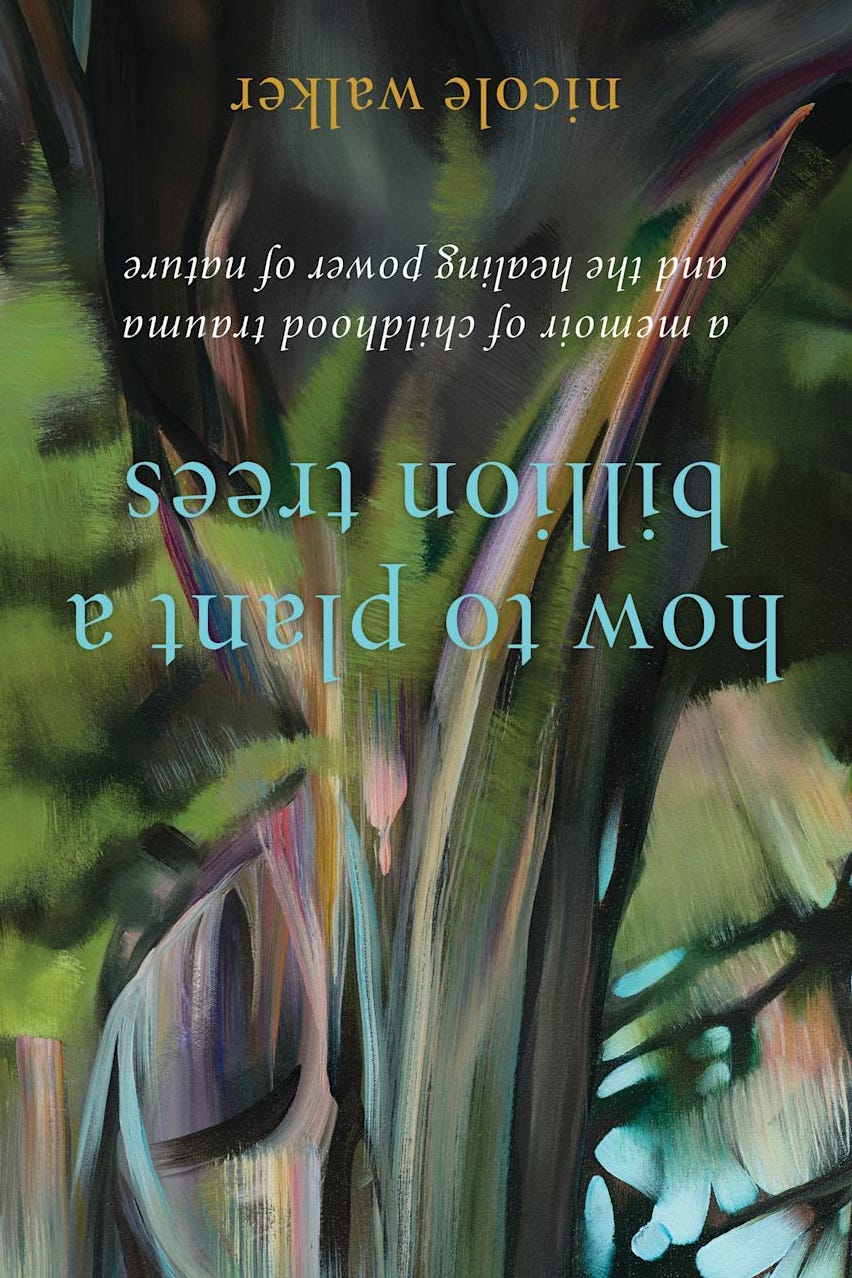
Publicity for A Billion Trees has been tricky so far. It’s tricky content. Although the book is about rebuilding oneself thanks to a large, supportive community, perhaps talking about abortion and molestation puts people off. It certainly puts people off from arresting child molesters detailed in the Epstein Files! But it’s also that there are a lot of books in the world. How do you make yours distinct? Personally, the cover is the big sales strategy for me. My dear friend Rebecca let me use a detail of one of her tree paintings. To me, this makes the book. The back cover also helps. I had an extensive list of people who I suggested blurb the book. I ended up with 4 beautiful blurbs that not only say kind things about the book but that also show how they understood what the book is trying to do.
Bloomsbury is big. There are a lot of imprints and editors. Like a Big 5 press, there’s a chance your book will get lost in the crowd. I thought about hiring my own publicist but after talking with two friends who had hired one for their books, I thought I could do most of the work myself. And then I found out A Billion Trees had a publicist and a marketing person. We haven’t had a ton of success yet with book reviews. The space for book reviews continues to shrink. The Washington Post cut their entire review section. As more places shudder their books sections, the more competition there is for the bit of space that is smaller.
The legwork is mostly up to us! My friend sold 3,000 copies of her first book by going on an International Book Tour (the international part was in Vancouver, BC, but that counts!) I try to go on book tours to places where I have friends whose house I can stay at or nearby. But I saved up a little money so I can read in NYC!
There are days of deep discouragement. My publicist and I each emailed 45 podcasters and came back with only 3 interviews so far. But I’m going to try a new tactic with some of the writing-centered ones and forward Writing the Hard Stuff, which, though hard, might be easier to discuss than A Billion Trees. I have set up a Story Graph giveaway. Over a thousand people have entered to win. I don’t have any context for whether this is a big or small number, but it can’t hurt to have 1,000 people to have heard of it. And, so far, no big interviews in the NYT or Kirkus. In a previous Substack, I wrote about On the Calculation of Volume. The narrator, Tara, lives the same day, November 18th, over and over again. It’s a lesson in love, but also in writing. She pays attention to more and more detail, filling the days with abundance. But it’s also about patience. I wake up hoping for book news. Most days, there is no book news. I’ve been here before. It’s not the healthiest place to live, but unlike Tara, I can, usually catapult out of the waiting and hoping for good news and digesting the non- or bad news.
Teaching is the primary way I abstract myself from the very-narrow purview of book publicity. My students remind me that books are for reading and talking—not worrying about! There are so many good books and some many good ideas. And when I read their writing, I realize that we are all working to make words and ideas matter. To be in on a collaborative project across a semester, across campuses, across years, across all kinds of readers and writers makes me get out of my own pathetic strivings. I just need to kick myself out of the computer and into the world sometimes.
I also get out of the very narrow book-self thinking by putting on my editing hat. For the other side of the publishing game, I also serve as the Series Editor for Crux--the nonfiction imprint at the University of Georgia Press. We receive about 300 manuscripts a year--some of which are proposals but most are full manuscripts. We are looking for books where personal stories intersect with historical, cultural, environmental, or global contexts. We publish some conventional memoir, but we keep our mind open for any form of nonfiction that has a unique voice, a confident sense of purpose, and playful, elegant language. The word Crux serves as a guide—Does the book get to the heart of the matter? It doesn’t matter how many hearts, just that the writing illustrates the point, purpose, and importance of those hearts. We’re open to all forms and love to see work that pushes the boundaries of creative nonfiction, while still considering the place of the reader.
This too is stressful. There are so many good books. I argue that we could easily publish 50% of the books we receive. It’s helpful to have CRUX as a lens through which to review manuscripts, because some just don’t fit the scope of our series, even if there is much to admire in those manuscripts. It’s also hard because I know a lot of the people who submit because of the conference I am co-president of, NonfictioNOW, from going to AWP for the last 2,000 years, and for spending too much time on Facebook and Bluesky. Knowing that there are so many good manuscripts is tough on that existential level—can each of them get published? Can we read them all? Or at least the ones that are meant for us? But it also helps one’s sagging-heart-book-worries. We’re in this together. We’re writing and submitting and publishing. No one has the exact key. I mentioned this elsewhere but each book, even each manuscript, is a riparian ecosystem. Every book contributes to the soil, the stones, the banks. Some people’s books fall into the river of fame, but that doesn’t make the other books any less important. We bank-books can still enjoy each other’s company. Big Book Sales. Or Fame. (I remind myself. Daily). Having readers is the dream. Even if it’s just a few.
Sagging-heart-book-worries. Ugh. That's right where I am, and I hope each day for good book-news to pull me out. Of course, when it comes, it only works for a while. Like heroin. In six days I'll have, gods willing, thirty-four years clean. You'd think I would have learned something! And of course I have. I'm still alive, still writing. Despite and because of the emotional obstacles.
And congratulations! I'm ready and waiting to read....